


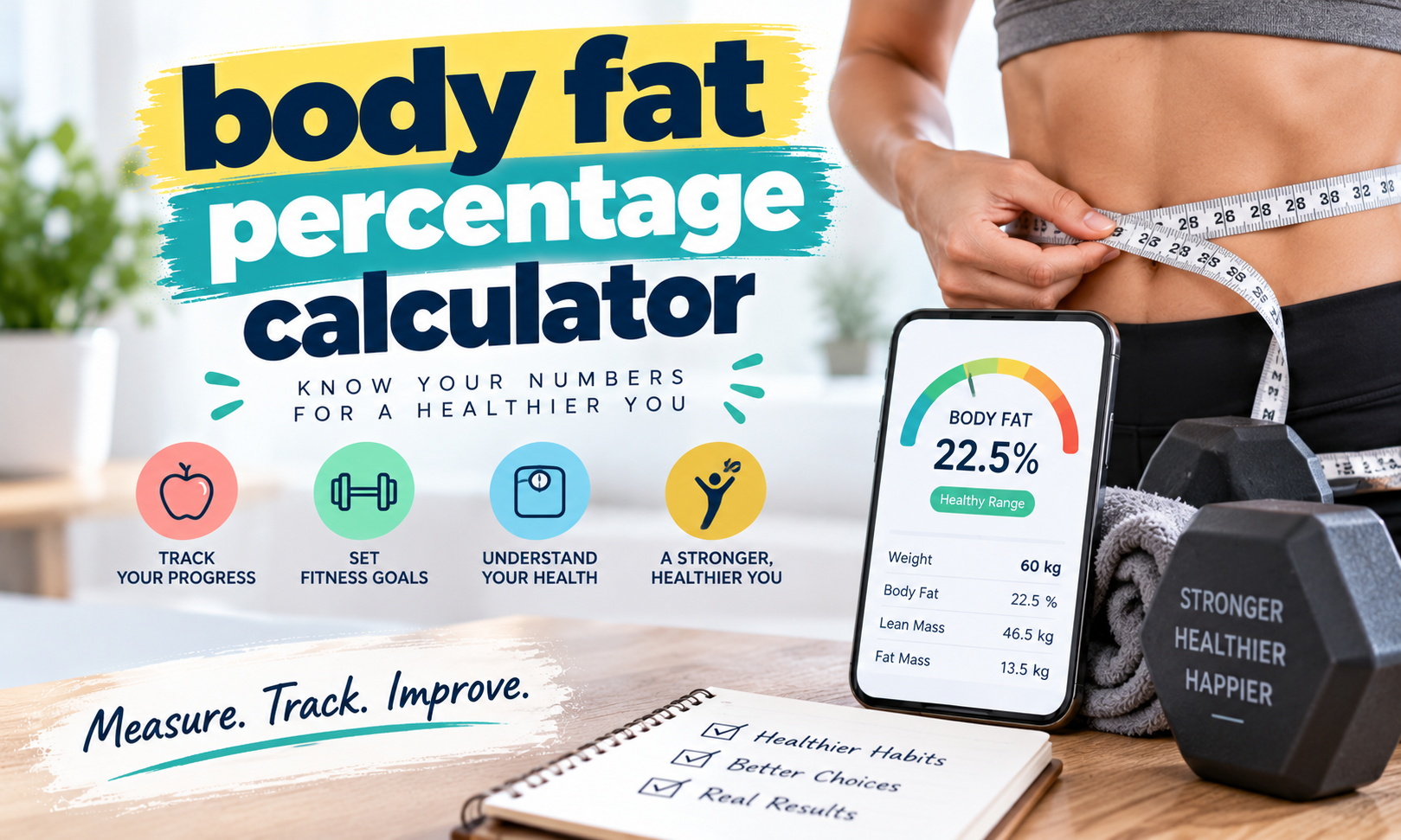
A body fat percentage calculator can give you a quick estimate of how much of your total body weight comes from fat. Depending on the calculator, it may use your height, weight, age, sex, waist and neck measurements, or a combination of those inputs to estimate body fat percentage.
The result can be useful for tracking changes over time, especially when body weight alone does not tell the whole story. However, no online calculator can directly measure body fat. Every equation relies on assumptions, and results can differ from DEXA, skinfold testing, bioelectrical impedance, air displacement, or other body-composition methods.
What Does Body Fat Percentage Actually Mean?
Body fat percentage is the proportion of your total body weight that comes from fat mass. The rest of your weight includes muscle, bone, organs, water, connective tissue, and other fat-free tissues.
For example, two adults can weigh the same and have the same BMI while carrying very different amounts of muscle and fat. That is one reason people often use body fat estimates alongside body weight, waist circumference, strength, fitness, blood pressure, cholesterol, and other health information.
Body fat itself is not inherently bad. Essential fat supports hormones, cell membranes, temperature regulation, energy storage, and normal organ function. The goal should not be to reduce body fat as low as possible.
How Does a Body Fat Percentage Calculator Work?
Most online calculators do not measure fat directly. They estimate it from variables that tend to correlate with body composition.
A calculator may use BMI plus age and sex, body circumferences such as the waist and neck, or equations developed from large groups of people who had their body composition measured using a reference method.
The final number is best viewed as an estimate with a margin of error rather than a precise laboratory result.
| Calculator Type | Typical Inputs | Main Advantage | Main Limitation |
| BMI-based estimate | Height, weight, age, sex | Fast and easy with no tape measurements | Can misclassify muscular or atypical body types |
| Circumference estimate | Height plus waist, neck, and sometimes hip | Uses body shape rather than weight alone | Tape placement and technique affect the result |
| Smart scale / BIA | Electrical impedance plus profile data | Convenient for repeated home tracking | Hydration, meals, exercise, and device equations affect readings |
| Skinfold estimate | Caliper measurements at specific sites | Low-cost when performed by a trained tester | Tester skill strongly affects accuracy |
| DEXA scan | Imaging scan | Provides regional and total body composition data | More expensive and not an online calculator |
Can BMI Be Used to Estimate Body Fat Percentage?
Yes, but BMI itself is not body fat percentage. BMI is weight relative to height. The CDC notes that BMI does not distinguish fat from muscle or bone and does not show where fat is stored.
For more detail on those limitations, see the CDC explanation of BMI and body composition.
Some calculators go one step further and use BMI in a body-fat prediction formula. One widely cited adult equation developed by Deurenberg and colleagues is:
Estimated body fat percentage = 1.20 x BMI + 0.23 x age – 10.8 x sex – 5.4
In that equation, sex is coded as 1 for males and 0 for females. The original study reported an estimated standard error of about 4.1 percentage points of body fat in adults, which shows why the output should not be treated as exact.
BMI-based equations can be less useful for bodybuilders, strength athletes, very muscular people, older adults with low muscle mass, or anyone whose body composition differs substantially from the population used to build the formula.
How Does a Navy-Style Body Fat Calculator Work?
Another common online method is based on circumference measurements. The U.S. Navy has long used body circumference measurements as part of its body composition assessment process.
The current Navy guide uses height and circumference values to estimate body fat through official tables. For men, the key circumference value is based on abdominal circumference minus neck circumference. For women, the value is based on waist plus hip circumference minus neck circumference.
The current U.S. Navy Body Composition Assessment guide also makes clear that this is an estimate used for Navy screening rather than a direct measurement of fat tissue.
Many consumer websites use mathematical versions of the Navy circumference approach. Small differences in where the tape is placed, how tightly it is pulled, and whether the measurement is taken after exhaling can change the result.
What Measurements Do You Need for a Circumference Calculator?
| Measurement | Why It Is Used | How to Improve Consistency |
| Height | Scales circumference values to body size | Measure without shoes and use the same method each time |
| Waist or abdomen | Captures central body size | Use the exact anatomical site required by the calculator |
| Neck | Part of the Navy-style circumference relationship | Keep tape level and avoid compressing the skin |
| Hip | Used in some female-specific circumference methods | Measure the widest required point consistently |
| Body weight | Needed for BMI-based estimates and fat-mass calculations | Measure under similar conditions each time |
| Age | Some equations account for age-related body-composition differences | Enter actual age rather than rounding categories |
How Accurate Are Online Body Fat Calculators?
Accuracy varies. A well-designed calculator can provide a reasonable population-based estimate, but the number can be several percentage points away from a more direct measurement.
The problem is not necessarily that the formula is poorly designed. Human bodies vary in muscle mass, bone structure, fat distribution, age-related changes, ethnicity, hydration, and other factors that a simple equation cannot fully capture.
For personal tracking, consistency is often more useful than chasing the supposedly perfect number. If you use the same calculator, the same tape-measure technique, and similar measurement conditions each month, the trend may be more meaningful than the absolute result.
Is DEXA the Most Accurate Way to Measure Body Fat?
DEXA, also written DXA, is one of the most commonly used clinical and research tools for estimating body composition. It uses low-dose X-rays to estimate bone mineral content, lean tissue, and fat tissue across different regions of the body.
The CDC specifically mentions DEXA as a method that can precisely assess body composition, while also noting that it is more expensive and less widely available than BMI.
DEXA is not a perfect gold standard for every situation, and results can still vary with machine calibration, hydration, body size, and analysis software. Still, it provides much more detailed information than a simple online calculator.
What Is Bioelectrical Impedance and Why Do Smart Scales Change So Much?
Bioelectrical impedance analysis, or BIA, estimates body composition by sending a very small electrical current through the body and measuring resistance. Because water-rich lean tissue conducts electricity differently from fat tissue, the device uses impedance plus a prediction equation to estimate body composition.
The convenience is excellent, but readings can change because hydration has a major effect on electrical conductivity. Meals, alcohol, recent exercise, sweating, temperature, and time of day can also change the result.
A National Institutes of Health assessment of bioelectrical impedance analysis and body composition notes that hydration, food and beverage intake, recent physical activity, body position, and temperature can influence BIA measurements.
If you use a smart scale, measure under similar conditions each time. For example, use it in the morning after using the bathroom and before breakfast, rather than comparing a morning reading with one taken after a workout and a large meal.
Are Skinfold Calipers More Accurate Than a Calculator?
They can be, especially when a trained person performs the same standardized sites repeatedly. Skinfold testing estimates subcutaneous fat thickness at specific body locations and applies a validated equation to estimate body density and body fat percentage.
The biggest limitation is technique. Pinch location, caliper placement, timing, and the tester’s skill can all affect the result. Self-measurement is especially difficult at several standard sites.
For tracking progress, having the same trained tester perform the same protocol can improve consistency.
What About Hydrostatic Weighing and the Bod Pod?
Hydrostatic weighing estimates body density from underwater weight, while air-displacement plethysmography, commonly known through devices such as the Bod Pod, estimates body volume from air displacement.
Both can provide useful body-composition estimates, but they require specialized equipment. They are more common in sports performance centers, research settings, and some universities than in ordinary home use.
What Can Make a Body Fat Reading Change From Day to Day?
| Factor | Which Methods It Affects Most | How to Reduce the Noise |
| Hydration | BIA and scale-based estimates | Measure at the same time of day under similar hydration conditions |
| Recent meal | BIA, scale weight, waist measurement | Measure before eating when possible |
| Recent exercise | BIA and circumference | Avoid comparing post-workout readings with rested readings |
| Tape placement | Circumference calculators | Use the same anatomical landmark every time |
| Tester technique | Skinfolds and circumferences | Use the same trained tester when possible |
| Device algorithm | Smart scales and handheld BIA | Do not compare percentages from different brands as if they are interchangeable |
| Weight change | BMI-based formulas | Remember that weight loss can include water, fat, and lean tissue |
What Is a Healthy Body Fat Percentage?
There is no single body fat percentage that is ideal for every adult. Body fat differs naturally with sex, age, genetics, hormone status, athletic background, pregnancy history, and life stage.
Fitness organizations publish descriptive body-fat ranges, but those ranges should not be treated as universal medical cutoffs. A person’s blood pressure, cholesterol, blood sugar, waist circumference, fitness, diet, smoking status, family history, and other factors may provide more useful information about health risk than one body-fat estimate.
Very low body fat can also be harmful. Inadequate energy availability can affect hormones, bone health, reproductive function, immune function, and athletic performance.
Is Body Fat Percentage More Useful Than BMI?
They answer different questions. BMI is a simple screening measure based on height and weight, while body fat percentage tries to estimate how much of that weight is fat.
For a muscular athlete, body fat percentage may provide context that BMI misses. For population-level screening, BMI is much easier to collect and still has strong value.
Neither number should be used alone to diagnose health. The CDC recommends considering BMI together with medical history, health behaviors, physical examination, blood pressure, laboratory results, and other relevant information.
How Should You Use a Body Fat Calculator for Progress Tracking?
Use it as a trend tool. Choose one method, measure under similar conditions, and avoid reacting to small day-to-day changes.
Monthly or every-four-to-six-week comparisons are often more useful than daily body-fat estimates. Short-term changes in hydration can move smart-scale readings even when actual fat mass has not meaningfully changed.
Pair the estimate with body weight, waist measurement, progress photos if you choose to use them, gym performance, and how clothing fits. That provides a broader picture than one percentage.
Can You Calculate Fat Mass From Body Fat Percentage?
Yes. Once you have an estimated body fat percentage, you can estimate fat mass and fat-free mass.
Estimated fat mass = body weight x body fat percentage as a decimal.
For example, if a person weighs 180 pounds and an estimate says 25 percent body fat, estimated fat mass would be 45 pounds. Estimated fat-free mass would be approximately 135 pounds.
Because the body fat percentage itself is only an estimate, the fat-mass result is also an estimate.
What Is the Best Method for Someone Trying to Lose Fat?
The best method is usually the one you can repeat consistently without creating unnecessary stress. A tape measurement or home scale may be less accurate than DEXA, but it can be more practical for regular tracking.
If you are making a major body-composition change, an occasional DEXA or professional assessment can provide a more detailed reference point. Between those assessments, body weight, waist circumference, strength, and one consistent home method may be enough.
When Should You Avoid Relying on a Body Fat Calculator?
Be cautious when using a standard calculator during pregnancy, in people with significant fluid retention or dehydration, in certain medical conditions that alter body water, or in people at extremes of muscularity or body size.
Children and teenagers also require age-specific assessment rather than adult body-fat or BMI interpretations. Growth, puberty, and development change the relationship between height, weight, and body composition.
If body composition is being evaluated for a medical reason, such as unexplained weight change, eating-disorder concerns, metabolic disease, or treatment monitoring, a healthcare professional should guide the assessment.
Frequently Asked Questions About Body Fat Percentage Calculators
How accurate is a body fat percentage calculator?
Accuracy depends on the method and the person. Online formulas can be several percentage points away from DEXA or other body-composition tests. They are more useful for estimating and tracking trends than for producing an exact number.
Is the Navy body fat calculator accurate?
It can provide a useful circumference-based estimate, but tape placement and body shape influence the result. The current Navy method itself treats the percentage as an estimate for body composition assessment.
Is a smart scale accurate for body fat?
Smart scales can be useful for tracking trends, but hydration, meals, exercise, temperature, and the device’s prediction equation can change the reading. Use the same scale under similar conditions.
Is DEXA better than an online calculator?
DEXA provides a more detailed body-composition assessment and is generally more informative than an online formula, but it costs more and is not necessary for routine tracking.
Can BMI tell me my body fat percentage?
BMI does not directly measure body fat. Some equations use BMI, age, and sex to estimate body fat percentage, but the result is still a prediction.
How often should I measure body fat?
For most fitness goals, every four to six weeks is more useful than daily measurement. Actual fat tissue changes more slowly than hydration-related fluctuations in many home devices.
Why do two body fat calculators give different answers?
They may use different equations, assumptions, measurement sites, or population data. Do not expect different methods or brands to produce identical percentages.
Should I try to reach the lowest body fat percentage possible?
No. Body fat is necessary for normal physiology. Extremely low levels can harm hormone function, bone health, immune function, reproductive health, and performance.
Final Thoughts
A body fat percentage calculator can be a useful starting point, but it should be treated as an estimate rather than a diagnosis. BMI-based formulas are fast, circumference calculators add information about body shape, and smart scales make frequent tracking convenient, but all of these approaches have limitations.
If accuracy matters more than convenience, DEXA, professionally performed skinfold testing, air-displacement methods, or other validated assessments can provide additional information.
For everyday fitness tracking, consistency usually matters most. Use the same method, measure under similar conditions, watch the long-term trend, and interpret the number alongside waist circumference, fitness, health markers, and how you feel rather than judging health from one percentage alone.
This article is written for a U.S. audience using body-composition guidance and research available in October 2026. Body-fat estimates are not a substitute for medical evaluation. People with pregnancy, eating-disorder concerns, significant fluid imbalance, unexplained weight change, or other medical conditions should seek individualized guidance from a qualified healthcare professional.




Discussion about this post