


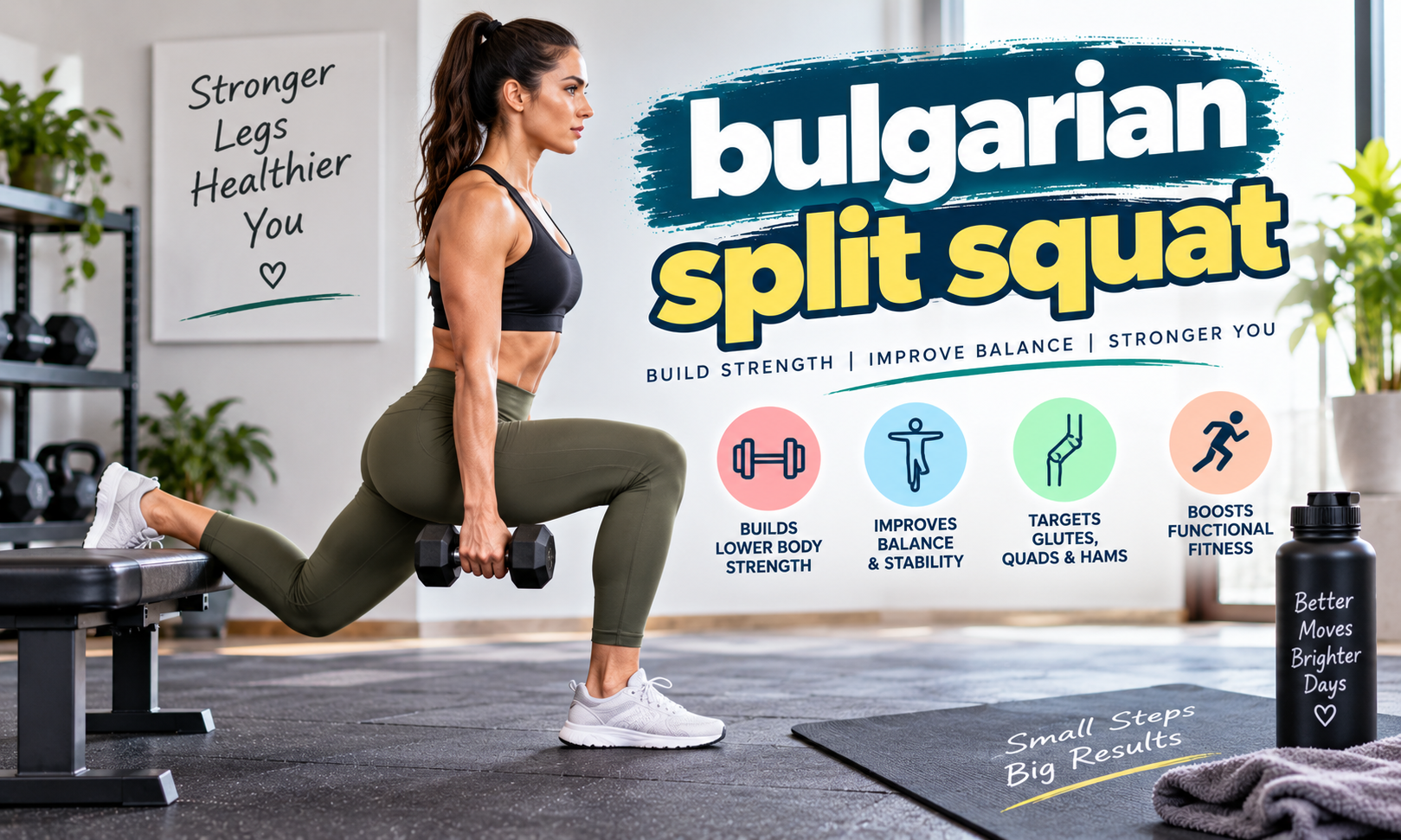
The bulgarian split squat is one of the most effective lower-body exercises for training one leg at a time. It combines a split stance with the rear foot elevated on a bench or box, forcing the front leg to handle most of the work while the hips, core, and smaller stabilizing muscles help control balance.
The exercise is popular with strength trainees, athletes, runners, and people who want stronger legs without relying only on heavy bilateral squats. It can be performed with body weight, dumbbells, a barbell, kettlebells, a Smith machine, or resistance bands, and small changes in stance and torso angle can shift emphasis between the quadriceps and glutes.
What Is a Bulgarian Split Squat?
A Bulgarian split squat is a unilateral lower-body exercise in which one foot stays on the floor while the rear foot rests on an elevated surface. The front leg performs most of the lifting as the lifter lowers the rear knee toward the floor and then drives back up.
It is often called a rear-foot-elevated split squat. Unlike a traditional back squat, where both feet share the load, the Bulgarian version concentrates much more of the challenge on one side at a time.
ACE’s Bulgarian split squat exercise guide describes a setup with the rear foot on a knee-height bench or box, the torso controlled, and the front foot driving into the floor during the ascent.
Which Muscles Does the Bulgarian Split Squat Work?
The main working muscles are the quadriceps, gluteus maximus, hamstrings, and hip stabilizers. The calves, abdominal muscles, and spinal stabilizers also contribute because the movement requires balance and trunk control.
The front leg is responsible for most of the force production. The rear leg assists with balance and can contribute some force, but it should not become the primary driver of the movement.
| Muscle Group | Role in the Exercise | When It Is Emphasized More |
| Quadriceps | Extend the knee and help drive the body upward | More upright torso and slightly shorter front stance |
| Gluteus maximus | Produces hip extension during the ascent | Longer stance and moderate forward torso lean |
| Hamstrings | Assist hip extension and stabilize the knee | Longer stance and hip-dominant setup |
| Gluteus medius | Helps control pelvic position and knee alignment | Any strict single-leg setup with controlled balance |
| Core | Resists unwanted trunk rotation and side bending | Heavier loads, offset loads, and slower reps |
| Calves | Help stabilize the ankle and maintain foot pressure | Deeper reps and less external support |
What Does Research Say About the Bulgarian Split Squat?
Biomechanics research supports using the movement as a hip-dominant unilateral strength exercise. A 2021 study comparing Bulgarian split squats with bilateral back squats found that both exercises placed large demands on the hip, but the Bulgarian split squat showed lower knee-joint demand in the study conditions.
The full study is available through PubMed’s review of biomechanical differences between the Bulgarian split squat and back squat.
That finding does not mean the exercise is automatically safe for every painful knee or that it should replace back squats. It does suggest that the movement can be useful when a program needs strong hip-extension work with a unilateral emphasis.
More recent research has also examined how torso angle and stance setup change muscle recruitment. A moderate forward torso lean generally shifts more emphasis toward the hip and gluteal muscles, while a more upright position tends to increase quadriceps contribution.
What Are the Main Benefits of Bulgarian Split Squats?
One major benefit is unilateral strength development. Training one side at a time makes it harder for the stronger leg to compensate for the weaker one, which can expose noticeable left-to-right differences.
The exercise can also challenge balance, hip stability, and trunk control more than many two-leg movements. That is useful for sports and daily activities where the body frequently supports itself on one leg during running, climbing stairs, cutting, stepping, and changing direction.
Another advantage is that the legs can be trained hard with less total external weight than a heavy back squat. That can reduce the amount of barbell load placed through the spine while still creating substantial local leg fatigue.
How Do You Perform a Bulgarian Split Squat Correctly?
Start with body weight until the setup feels repeatable. Stand roughly two feet in front of a stable bench or box that is around knee height or slightly lower. Place the top of one foot on the bench behind you.
Brace your core, keep the front foot planted, and lower under control by bending the front knee and hip. Let the rear knee travel down toward the floor rather than trying to move straight backward.
Descend only as far as you can while keeping the front foot stable and the pelvis controlled. Then press through the whole front foot and return to standing.
You should feel most of the effort in the front leg. If the rear leg cramps or feels like it is doing most of the pushing, adjust your distance from the bench and reduce the load.
How Far Should Your Front Foot Be From the Bench?
There is no single correct distance for everyone because leg length, hip mobility, ankle mobility, bench height, and training goal all affect stance.
A useful starting point is to step far enough forward that you can descend without feeling jammed at the front hip or forced onto the toes. The front heel should stay down throughout the repetition.
If the stance is too short, the movement can feel cramped and become heavily knee-dominant. If it is too long, you may struggle to reach depth or keep the pelvis square.
Should Your Knee Go Past Your Toes?
For many healthy lifters, some forward knee travel is normal and not automatically a mistake. The important issue is whether the movement is controlled, the heel remains grounded, and the knee tracks in line with the foot.
Trying to force the shin perfectly vertical can make the movement awkward and may shift too much stress toward the hip or lower back. Your individual anatomy and comfort matter more than following a rigid visual rule.
If you have knee pain, a recent injury, or rehabilitation restrictions, use the range and stance recommended by your physical therapist or healthcare professional.
How Can You Make the Exercise More Glute-Dominant?
To increase glute emphasis, use a slightly longer front stance and allow a moderate forward lean from the hips while keeping the spine controlled.
Think about pushing the floor away and finishing the rep by extending the hip rather than aggressively snapping the knee straight.
Do not exaggerate the lean or round the back. A small change in torso angle is enough to change where the effort is felt.
How Can You Make It More Quad-Dominant?
A slightly shorter stance and a more upright torso usually increase knee flexion and quadriceps demand. The front knee may travel farther forward as long as the heel stays planted and the motion remains comfortable.
Using a small heel wedge under the front foot can also increase knee flexion for some lifters, but that variation should be introduced only after the basic movement is stable.
What Are the Most Common Bulgarian Split Squat Mistakes?
| Common Mistake | Why It Causes Problems | How to Fix It |
| Front foot too close | Can feel cramped and unstable | Step farther forward and retest the descent |
| Front foot too far away | Can limit depth and make the rear hip uncomfortable | Move slightly closer to the bench |
| Pushing off the rear leg | Reduces front-leg training effect | Keep rear foot relaxed and drive through front foot |
| Front heel lifting | Reduces stability and changes force distribution | Reduce depth, adjust stance, or improve ankle position |
| Knee collapsing inward | Can reduce control at the hip and knee | Keep knee tracking over the foot and lower the load |
| Dropping too quickly | Makes balance and joint control worse | Use a controlled two- to three-second descent |
| Bench too high | Can create excess rear-hip stretch | Use a lower box or bench |
How High Should the Rear Foot Be?
The rear foot does not need to be elevated very high. A surface around knee height or slightly below works well for many people, and a lower surface can be more comfortable for lifters with tight hips or limited balance.
A bench that is too high can force the rear hip into an uncomfortable position and may encourage the lifter to overarch the lower back. The best height is the lowest one that allows a stable, repeatable setup.
Should You Use Dumbbells, a Barbell, or a Smith Machine?
Dumbbells are often the easiest weighted progression because they keep the center of mass low and allow you to drop the weights safely if balance is lost.
A barbell allows heavier loading but requires more balance and more confidence getting into position. It is better suited to experienced lifters.
A Smith machine removes some of the balance demand and can make it easier to train the legs close to muscular failure. That can be useful for hypertrophy-focused training when balance is otherwise the limiting factor.
Kettlebells, resistance bands, and goblet holds also work well. The best loading method is the one that lets you keep the target leg working without losing position.
How Many Sets and Reps Should You Do?
Beginners can start with 2 to 3 sets of 6 to 10 repetitions per leg using body weight or light dumbbells. The priority should be control and consistency rather than fatigue.
For muscle growth, 3 to 4 sets of roughly 8 to 15 reps per leg works well for many lifters. For strength, experienced trainees can use heavier resistance for sets of 5 to 8 reps, provided balance and technique remain solid.
Because the exercise is demanding, it usually does not need to be taken to absolute failure. Stopping with one to three good repetitions still possible can preserve technique and make recovery easier.
How Often Should You Train Bulgarian Split Squats?
One or two sessions per week is enough for many people, especially when the exercise is combined with squats, deadlifts, lunges, step-ups, or machine work.
For general health, the CDC’s adult physical activity guidance recommends muscle-strengthening activity on at least two days per week, covering all major muscle groups.
That guideline is broader than any single exercise. Bulgarian split squats can be one part of a complete lower-body plan rather than the entire plan.
Where Should Bulgarian Split Squats Go in a Workout?
Place them early in the session when strength and performance are the priority. For example, they can follow a main squat or deadlift movement.
If the goal is muscle growth rather than maximum strength, they can also work well after a machine squat or leg press when the legs are already warm.
Avoid placing highly technical balance-based versions at the very end of a session if fatigue makes your technique unstable.
Can Bulgarian Split Squats Replace Back Squats?
They can replace back squats in some programs, but they do not have to. The two exercises create different demands.
Back squats are useful for developing bilateral strength and loading the whole body heavily. Bulgarian split squats are useful for unilateral strength, hip stability, balance, and creating high leg effort with less total external load.
Many well-designed programs use both, especially when the lifter wants a combination of overall strength and single-leg control.
Are Bulgarian Split Squats Good for Runners and Athletes?
They can be useful because running and many sports involve repeated single-leg support. The exercise trains hip and knee control while challenging the body to resist unwanted rotation.
That does not mean Bulgarian split squats automatically improve every athletic skill. Sprinting, jumping, cutting, and sport-specific practice still need to be trained directly.
Think of the exercise as a strength foundation that may support athletic movement rather than a substitute for the movement itself.
Are Bulgarian Split Squats Good for Building Muscle?
Yes. The front leg can be taken through a long range of motion under significant tension, which makes the exercise effective for the quadriceps and glutes.
For hypertrophy, stability is valuable. If balance prevents the target muscles from working hard, lightly holding a rack with one hand or using a Smith machine can improve the training effect.
Progress should come from better control, deeper comfortable range, more repetitions, or gradually heavier resistance rather than adding weight at the expense of balance.
Can the Bulgarian Split Squat Help Identify Strength Imbalances?
Because each side works separately, the movement can reveal differences in strength, balance, hip control, or mobility.
A small difference between legs is common. If one side is dramatically weaker, painful, or unable to control the same range of motion, avoid forcing symmetry by adding extra weight to the weaker side.
Use the same basic workload for both legs and let the weaker side determine the load. Persistent pain or a major functional difference may warrant assessment by a physical therapist or qualified clinician.
What Are Useful Bulgarian Split Squat Variations?
| Variation | Main Benefit | Who It Suits |
| Bodyweight | Builds balance and technique | Beginners and warm-ups |
| Dumbbell | Simple progressive overload | Most gym lifters |
| Goblet | Keeps load centered and easier to control | Beginners moving into weighted work |
| Barbell | Allows heavier loading | Advanced lifters |
| Smith machine | Reduces balance demand | Hypertrophy-focused training |
| Front-foot elevated | Increases available range of motion | Lifters with good mobility and control |
| Offset dumbbell | Adds anti-rotation challenge | Athletes and core-focused training |
How Should Beginners Learn the Movement?
Start with a regular split squat before elevating the rear foot. This teaches the basic stance and lowering pattern without the added balance challenge.
Then use a low bench and hold onto a rack or wall lightly with one hand. Once you can perform controlled reps without pushing off the support, remove the hand assistance.
Only add external weight after both legs can complete the same range of motion with steady balance.
When Should You Avoid or Modify Bulgarian Split Squats?
Stop or modify the exercise if it causes sharp knee pain, hip pain, groin pain, numbness, or a feeling of instability that does not improve with setup changes.
People recovering from surgery or a significant lower-body injury should follow the progression given by their rehabilitation professional rather than using general fitness advice.
A lower rear-foot position, reduced range of motion, assisted split squat, or traditional split squat can make the movement more manageable while strength and mobility improve.
Frequently Asked Questions About Bulgarian Split Squats
What muscles do Bulgarian split squats work?
They mainly train the quadriceps, glutes, hamstrings, and hip stabilizers, with the core and calves helping maintain balance.
Are Bulgarian split squats better than regular squats?
They are not universally better. Bulgarian split squats emphasize one-leg strength and balance, while regular squats are better suited to heavy bilateral loading. Many programs benefit from using both.
Should Bulgarian split squats hurt your knees?
They should not cause sharp or worsening knee pain. Controlled knee travel can be normal, but persistent pain is a reason to modify the setup or seek professional assessment.
How many Bulgarian split squats should a beginner do?
A practical starting point is 2 to 3 sets of 6 to 10 controlled reps per leg using body weight or light resistance.
Which is better for glutes, a short or long stance?
A slightly longer stance combined with a moderate forward torso lean generally shifts more emphasis toward the glutes and hip extensors.
Can Bulgarian split squats build big legs?
Yes. When progressively loaded through a comfortable range of motion, they can provide a strong hypertrophy stimulus for the quadriceps and glutes.
Do you need to use a bench?
No. Any stable elevated surface can work. A lower box or step may actually be more comfortable and easier to control than a high bench.
Should the rear foot push into the bench?
The rear leg can contribute to balance, but the front leg should do most of the lifting. If the rear leg is doing most of the work, adjust your setup.
Final Thoughts
The Bulgarian split squat is a highly adaptable lower-body exercise that can build unilateral leg strength, improve balance, and challenge the quadriceps and glutes without requiring the same total external load as a heavy bilateral squat.
Good results depend on setup more than on using a very high bench or heavy weights. Find a stance that lets the front foot stay stable, lower under control, keep the knee tracking comfortably, and drive back up through the working leg.
Beginners can start with body weight and hand support, while advanced lifters can progress to dumbbells, barbells, Smith-machine work, or deeper front-foot-elevated variations. Use the movement as part of a complete strength program and adjust stance, range, and loading to match your goals and joint comfort.
This article is written for a U.S. audience using fitness and biomechanics sources available in October 2026. Exercise technique should be individualized. People with current injuries, recent surgery, or persistent joint pain should seek guidance from a qualified healthcare or rehabilitation professional.






Discussion about this post