


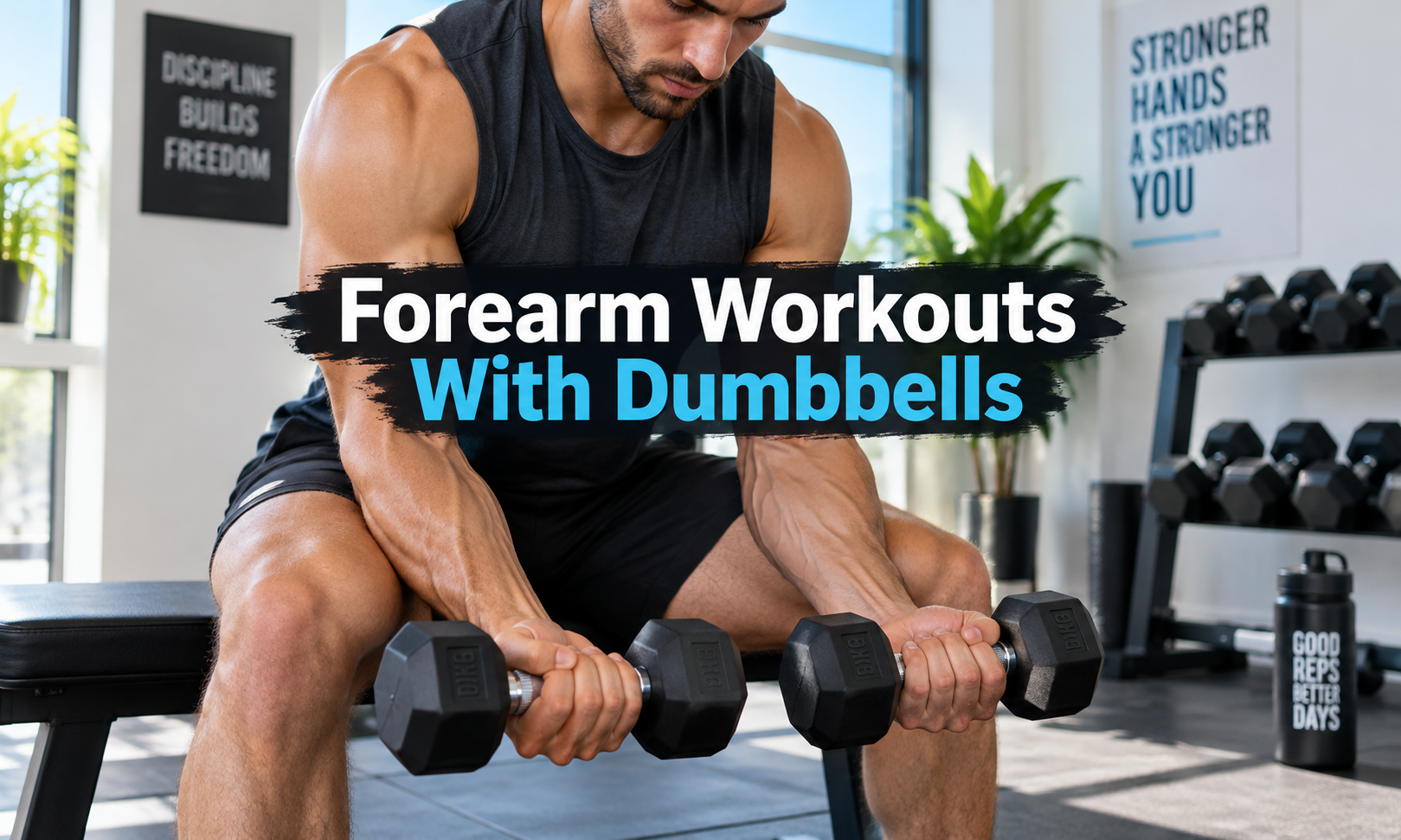
A practical routine for stronger wrists, grip, brachioradialis, and everyday lifting strength
The best forearm workouts with dumbbells train more than one type of movement. Your forearms control wrist flexion and extension, help rotate the forearm, stabilize the wrist during curls and presses, and provide the grip strength needed for rows, deadlifts, carries, pullups, and everyday tasks.
You do not need heavy weights to train them effectively. Wrist-focused exercises usually work best with light to moderate dumbbells and controlled motion, while carries and hammer-style curls can use heavier loads. A balanced routine should include wrist curls, reverse wrist curls, neutral-grip curls, rotation, and loaded carries.
Why Train Your Forearms Directly?
Forearm strength helps with opening jars, carrying groceries, lifting luggage, holding tools, and maintaining control during sports. In the gym, stronger forearms can make it easier to hold onto dumbbells, barbells, and pullup bars long enough for larger muscle groups to do their work.
Healthline’s 2026 update notes that forearm exercises can improve grip strength and everyday function and recommends dumbbell wrist curls, grip work, and farmer’s walks as practical options.
8 Effective Dumbbell Forearm Exercises
| Exercise | Main Focus | Sets x Reps | Training Note |
| Palms-up wrist curl | Wrist flexors | 2-3 x 10-15 | Use a light weight and full range |
| Palms-down wrist curl | Wrist extensors | 2-3 x 10-15 | Usually needs less weight than flexion |
| Hammer curl | Brachioradialis + biceps | 2-3 x 8-12 | Keep wrists neutral |
| Reverse curl | Forearm extensors + brachioradialis | 2-3 x 8-12 | Use an overhand grip |
| Dumbbell pronation/supination | Forearm rotation | 2 x 10-15 each way | Move slowly from the elbow |
| Grip crush | Finger flexors + grip | 2-3 x 8-15 | Let the dumbbell roll toward fingertips |
| Farmer carry | Grip + total forearm endurance | 2-4 x 20-40 sec | Stand tall and squeeze handles |
| Dumbbell hold | Isometric grip | 2-3 x 20-45 sec | Use heavier dumbbells with safe posture |
1. Palms-Up Wrist Curl
Sit on a bench or chair and rest your forearms on your thighs with your palms facing up. Let your hands extend just beyond your knees. Lower the dumbbells by extending the wrists, then curl them upward without lifting the forearms.
This targets the wrist flexors on the palm side of the forearm. Start light because the small wrist muscles fatigue quickly.
2. Palms-Down Wrist Curl
Use the same setup but turn your palms toward the floor. Raise the backs of your hands as high as you can while keeping your forearms supported, then lower slowly.
This trains the wrist extensors, which are often neglected. Use less weight than you would for palms-up curls and avoid jerking the dumbbells.
3. Hammer Curl
Hold a dumbbell in each hand with your palms facing each other. Curl the weights toward your shoulders while keeping the neutral grip, then lower under control.
Hammer curls train the brachioradialis, a prominent forearm muscle, while also working the biceps and brachialis. They are useful when you want forearm size and elbow-flexion strength at the same time.
4. Reverse Dumbbell Curl
Hold the dumbbells with an overhand grip, palms facing behind you. Keep the elbows close to your sides and curl without letting the wrists collapse.
Reverse curls challenge the brachioradialis and wrist extensors more than a standard palms-up curl. Use moderate weight and keep the movement strict.
5. Dumbbell Pronation and Supination
Hold one end of a light dumbbell so the weight is offset from your hand. Support your forearm on your thigh with your elbow bent about 90 degrees.
Slowly rotate from palm-up toward palm-down and back again. This trains the muscles that rotate the radius around the ulna. Use a very light dumbbell because leverage makes the movement more demanding than it looks.
6. Dumbbell Grip Crush
Sit with one forearm supported and hold a dumbbell loosely. Let it roll carefully toward your fingertips, then close your hand firmly around the handle and curl the wrist slightly upward.
This adds finger-flexor work to the wrist curl and directly challenges crushing grip strength.
7. Farmer Carry
Hold a heavy dumbbell in each hand and walk with your chest tall, shoulders controlled, and core braced. Squeeze the handles instead of letting the dumbbells hang passively from your fingers.
Healthline recommends farmer’s walks for forearm and grip strength. If you have limited space, walk back and forth or simply perform a timed standing hold.
8. Heavy Dumbbell Hold
Stand upright with a challenging dumbbell in each hand and hold them for 20 to 45 seconds. The goal is to maintain a secure grip and good posture throughout the set.
This is one of the simplest ways to build grip endurance. Stop the set if the weights begin slipping or your shoulders and spine lose position.
How Often Should You Train Forearms?
Two direct forearm sessions per week is enough for many people because the forearms also work during rows, pullups, deadlifts, curls, and carries.
The ACSM 2026 resistance-training position stand emphasizes that consistent progressive resistance training is more important than complicated programming. A practical approach is to train major muscle groups at least twice per week while gradually increasing resistance or training volume.
If your grip is already heavily taxed by back or deadlift training, place direct forearm work near the end of the session so it does not limit bigger compound lifts.
How Heavy Should the Dumbbells Be?
For wrist curls and rotation work, start lighter than you think you need. A weight that allows 10 to 15 clean repetitions with a smooth tempo is usually better than a heavy dumbbell that forces short, jerky motion.
For hammer curls, reverse curls, carries, and static holds, you can use heavier weights as long as the wrists stay neutral and the elbows, shoulders, and back remain controlled.
How Do You Progress?
Progress when you can complete the top of the repetition range comfortably with good form. Add a small amount of weight, an extra set, a few seconds to your carry, or slower lowering phases.
Forearm muscles and tendons can become irritated when volume increases too quickly. Small progressions are usually more sustainable than suddenly doubling weight or adding daily grip work.
What Mistakes Should You Avoid?
The most common mistake is using too much weight and turning wrist exercises into partial, bouncing movements. Another is training only the wrist flexors and ignoring extensors and rotation.
Pain at the wrist or elbow is not something to push through. Sharp pain, numbness, tingling, swelling, or persistent tenderness can signal tendon or nerve irritation and deserves rest or professional assessment.
Frequently Asked Questions
Can dumbbells make your forearms bigger?
Yes. Progressive wrist curls, reverse curls, hammer curls, and carries can increase forearm muscle size when combined with enough training volume, protein, and recovery.
Are hammer curls enough for forearms?
They are excellent for the brachioradialis, but they do not fully train wrist flexion, extension, rotation, or grip endurance. A complete routine includes several movement types.
Should I train forearms every day?
Usually not. The forearms already work during many pulling and gripping exercises, so two or three direct sessions per week is plenty for most people.
Why do my forearms burn so quickly?
Forearm muscles are relatively small and often perform continuous gripping work. High-repetition wrist exercises and carries can create a strong local fatigue sensation quickly.
Do farmer carries build forearms?
Yes. Heavy carries challenge grip strength and forearm endurance while also training the shoulders, upper back, and core.
Can I do these exercises at home?
Yes. A pair of dumbbells is enough for the entire routine. Adjustable dumbbells are especially useful because wrist exercises often need lighter loads than carries or curls.
Final Thoughts
A complete dumbbell forearm routine should include wrist flexion, wrist extension, neutral-grip curls, overhand curls, rotation, and loaded grip work. You do not need heavy weights for every exercise. Controlled technique and gradual progression matter more.
Train forearms consistently two or three times per week, place them after larger pulling exercises when possible, and increase resistance slowly. That approach can improve grip strength, wrist control, and forearm development without unnecessary strain.
This article is written for a U.S. audience using exercise guidance available in October 2026. People with wrist, elbow, hand, nerve, or tendon injuries may need individualized guidance from a physical therapist, physician, or qualified exercise professional.




Discussion about this post