


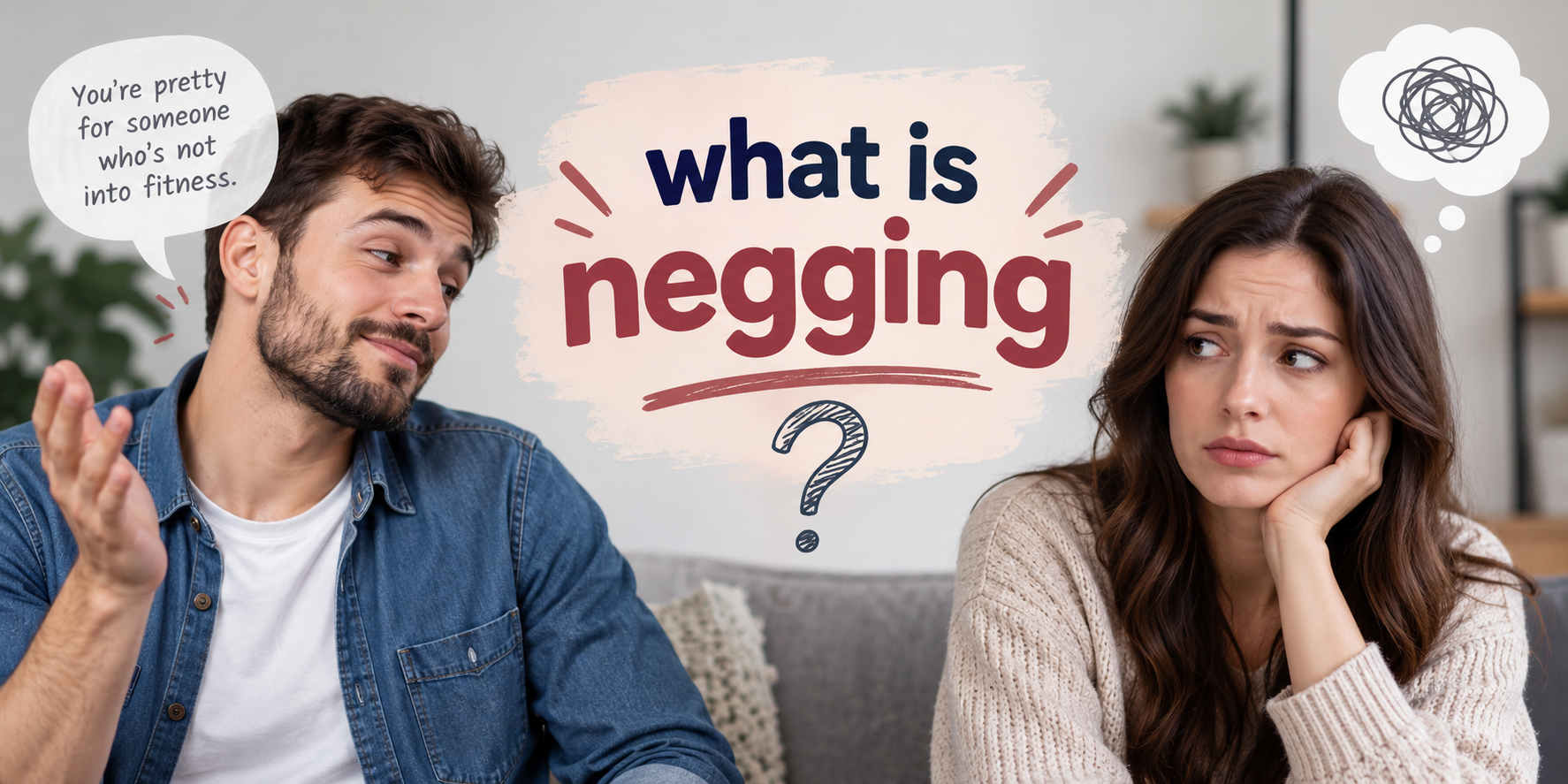
A concise guide to backhanded compliments, disguised insults, emotional manipulation, boundaries, and warning signs
If you are wondering what is negging, it generally refers to repeated backhanded compliments, subtle put-downs, comparisons, or disguised insults that are used to undermine another person’s confidence. A typical comment sounds partly positive but leaves the recipient feeling embarrassed, insecure, or eager to win the other person’s approval.
One awkward joke or poorly worded comment does not automatically mean someone is negging. The concern is the pattern: the remarks keep happening, the same person repeatedly targets your insecurities, and your discomfort is minimized with responses such as ‘I was only joking’ or ‘You’re too sensitive.’
Why Do People Use Negging?
Negging is often described as a form of emotional manipulation because it can create an uneven dynamic. By lowering another person’s confidence, the person making the remarks may feel more powerful, desirable, or in control.
The tactic became well known through dating and pickup culture, where it was promoted as a way to make someone seek validation. In reality, negging can happen in romantic relationships, friendships, families, workplaces, and other settings.
Intent can be difficult to prove from one sentence. What matters more is the repeated effect and whether the person changes after you tell them the behavior is hurtful.
What Does Negging Look Like?
| Pattern | What It Sounds Like | Why It Can Be Manipulative |
| Backhanded compliment | Praise followed by a put-down | Creates uncertainty instead of genuine encouragement |
| Negative comparison | Comparing you unfavorably with an ex, friend, coworker, or ideal | Pushes you to compete for approval |
| Insult disguised as humor | A cutting comment followed by ‘just kidding’ | Makes it harder to challenge the remark |
| Undermining question | Acting surprised you succeeded or implying someone must have helped | Questions your competence |
| One-upping | Turning your achievement into proof that theirs is better | Shifts attention away from your success |
| Blaming sensitivity | Saying you cannot take a joke when you object | Redirects responsibility from the comment to your reaction |
How Is Negging Different From Teasing?
Healthy teasing usually feels mutual. Both people can laugh, neither person is regularly humiliated, and the joking stops when someone says it has crossed a line.
Negging feels different because the humor tends to move in one direction. It targets appearance, intelligence, achievements, social status, personality, or another insecurity and is often followed by denial or minimization.
A useful test is the response to a boundary. Someone who made an accidental hurtful joke is more likely to apologize and adjust. Someone using manipulation may argue, mock the boundary, insist you are overreacting, or repeat the behavior.
Is Negging the Same as Constructive Criticism?
No. Constructive criticism addresses a specific behavior or problem and is usually aimed at helping. It can still be uncomfortable, but it is direct, respectful, and focused on something that can be changed.
Negging is more personal. It often attacks identity or self-worth while pretending to be helpful, playful, or complimentary. The result is confusion rather than useful feedback.
Can Negging Become Emotional Abuse?
It can. Negging by itself is a behavior, and one comment does not define an entire relationship. But when repeated put-downs are part of a larger pattern of humiliation, control, isolation, jealousy, intimidation, or gaslighting, the situation may fit a broader pattern of emotional abuse.
The National Domestic Violence Hotline’s explanation of emotional abuse describes nonphysical behaviors such as insults, manipulation, humiliation, monitoring, dismissiveness, and control as common warning signs.
Healthline also notes that repeated negging can damage self-esteem and may escalate into more serious emotional or physical mistreatment.
What Are Signs the Pattern Is Affecting You?
You may start second-guessing ordinary choices, changing how you dress or speak to avoid criticism, or feeling relieved when the person finally offers approval.
Other warning signs include frequently feeling embarrassed around them, rehearsing conversations in advance, defending them to friends, withdrawing from people who question the relationship, or feeling as though every disagreement somehow becomes your fault.
These reactions do not prove that someone is deliberately manipulating you, but they are useful signals that the relationship dynamic deserves attention.
How Can You Respond to Negging?
Start by naming the specific behavior rather than debating the person’s personality. A clear response can be as simple as saying that the comment felt insulting and that you do not want to be spoken to that way.
You do not need to prove that the person intended harm before setting a boundary. The effect on you is enough reason to ask for different behavior.
Then watch what happens next. A respectful person may disagree about intent but still care that the comment hurt you. A manipulative response is more likely to include ridicule, blame, denial, or repeated testing of the same boundary.
Should You Argue About Whether It Was ‘Just a Joke’?
Usually, the more useful question is whether the behavior stops. Humor does not require everyone to pretend a hurtful remark was harmless.
If someone repeatedly uses ‘just joking’ as a shield after comments that target your insecurities, focus on the pattern rather than trying to win an argument about each individual sentence.
What If Negging Happens at Work?
Workplace negging can look like belittling comments about competence, intelligence, appearance, or achievements disguised as banter. Document recurring incidents, including dates, wording, witnesses, and how the comments affected your work.
If direct boundary-setting does not help or feels unsafe, consider speaking with a supervisor, human resources representative, union representative, or another appropriate workplace contact according to your organization’s policies.
When Is It Time to Step Back From the Relationship?
A relationship deserves serious reconsideration when put-downs continue despite clear boundaries, your confidence is steadily deteriorating, or the behavior is combined with threats, monitoring, financial control, isolation, stalking, intimidation, or physical aggression.
If you feel unsafe, prioritize safety over confrontation. A trusted friend, family member, counselor, local support service, or domestic violence advocate can help you think through options without requiring you to make an immediate decision.
Frequently Asked Questions About Negging
Is negging always intentional?
Not necessarily. A single backhanded comment may be careless. The stronger warning sign is a repeated pattern that continues after the person knows it is hurtful.
Can friends use negging?
Yes. Negging can happen in friendships, families, workplaces, and romantic relationships. It is not limited to dating.
Is negging the same as gaslighting?
No. Negging undermines confidence through put-downs or backhanded praise. Gaslighting involves trying to make someone doubt their memory, perception, or reality. The two can occur together.
Why does negging sometimes feel flattering at first?
Because it often starts with praise before adding a criticism. That mix can create confusion and make the recipient focus on earning the positive part again.
What is the best way to respond?
State the boundary clearly, avoid debating every detail, and pay attention to whether the person changes their behavior.
Can negging be emotional abuse?
Yes, when it is part of an ongoing pattern of humiliation, manipulation, control, intimidation, or other emotionally abusive behavior.
Final Thoughts
Negging is more than an awkward compliment when it becomes a repeated pattern of subtle insults, unfavorable comparisons, or jokes designed to lower confidence. The most useful clues are repetition, how the comments make you feel, and what happens when you set a boundary.
Healthy relationships allow people to disagree, joke, and give feedback without systematically undermining one another. If the pattern becomes controlling, humiliating, frightening, or difficult to escape, reaching out for outside support can help you assess the situation more clearly.
This article is written for a U.S. audience using relationship and mental-health guidance available in October 2026. Negging is a descriptive term, not a formal mental-health diagnosis.




Discussion about this post