


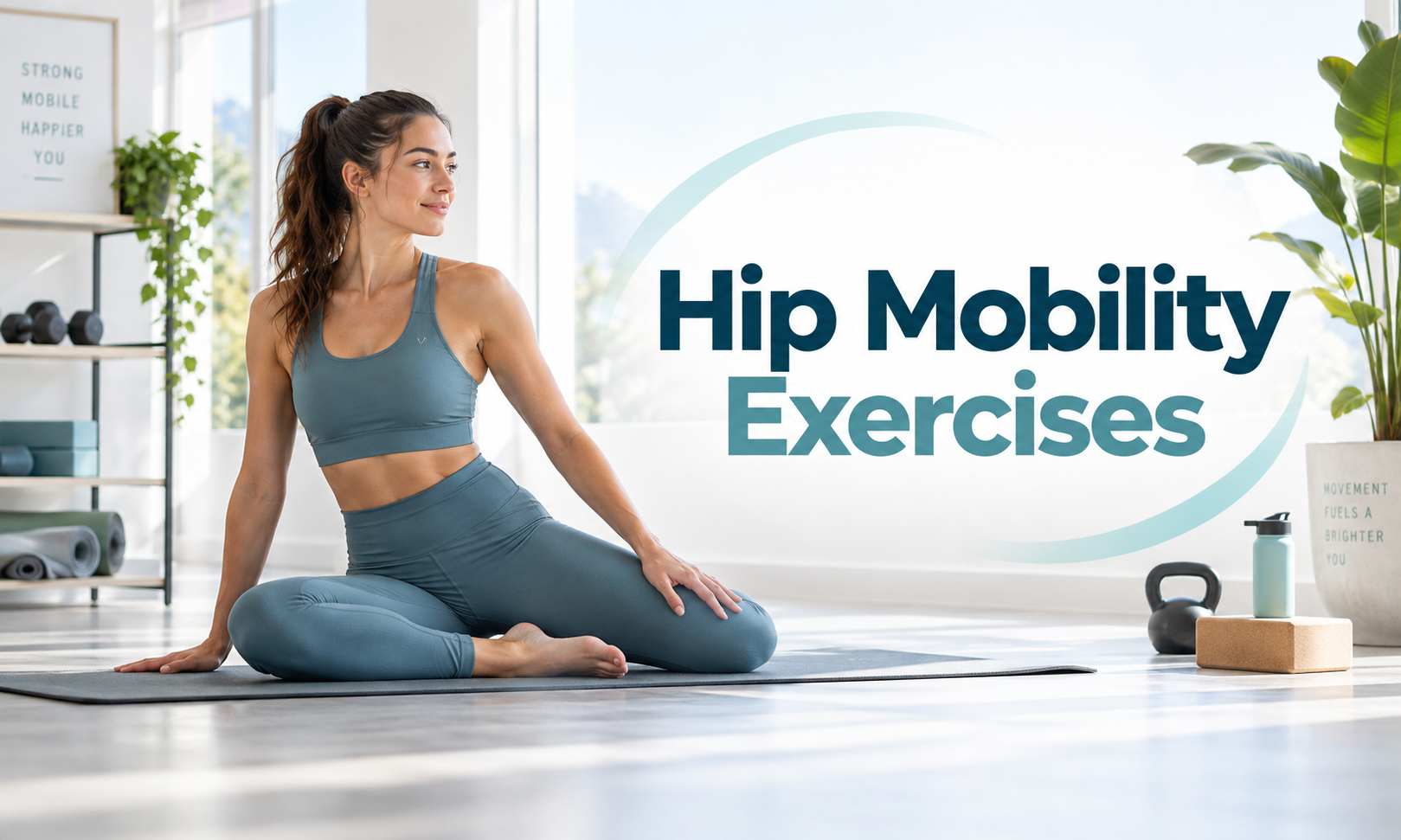
A practical routine for hip flexors, glutes, adductors, internal rotation, external rotation, and everyday movement
The best hip mobility exercises combine controlled movement, gentle stretching, and strength through the available range of motion. The goal is not simply to force the hips to feel looser. Good mobility means being able to move the hip joint through useful ranges with control, stability, and little or no pain.
A balanced routine should address hip flexion and extension, internal and external rotation, the glutes, hip flexors, and inner thighs. That can make walking, squatting, climbing stairs, running, and getting up from a chair feel smoother while also improving how the pelvis and lower back move together.
Why Hip Mobility Matters
The hips are involved in nearly every lower-body movement. Long periods of sitting can make the hip flexors feel tight, while limited rotation or weak glute muscles can make squats, lunges, and walking feel stiff or awkward.
Healthline’s hip-exercise guide notes that stretching and strengthening the muscles around the hips can improve stability and flexibility. It also highlights the gluteus maximus and gluteus medius as important muscles for hip extension and side-to-side control.
The American Academy of Orthopaedic Surgeons hip conditioning program similarly includes hip and hamstring stretches plus strengthening exercises to support flexibility, stability, and function.
8 Hip Mobility Exercises to Try
| Exercise | Main Focus | Suggested Dose | Best Use |
| Hip circles | General hip range of motion | 10-15 each direction | Warmup and daily mobility |
| 90/90 hip switches | Internal and external rotation | 2 sets of 6-10 | Rotational control |
| Half-kneeling hip flexor stretch | Hip extension and hip flexors | 20-30 sec each side | Sitting-related tightness |
| Knee-to-chest stretch | Hip flexion and glutes | 20-30 sec each side | Gentle mobility |
| Figure-four stretch | External rotation and glutes | 20-45 sec each side | Glute and outer-hip tightness |
| Adductor rock-back | Inner thigh mobility | 8-12 each side | Adductors and groin |
| Glute bridge | Hip extension strength | 2-3 sets of 10-15 | Active mobility and pelvic control |
| Single-leg Romanian deadlift | Hip hinge, hamstrings, balance | 2-3 sets of 6-10 each side | Strength through range |
1. Hip Circles
Stand next to a wall or sturdy chair for balance. Lift one knee and slowly draw a circle with the thigh, keeping the torso upright. Make the circle as large as you can without pinching or twisting through the lower back.
Hip circles are useful before workouts because they take the joint through flexion, abduction, extension, and rotation in one controlled movement.
2. 90/90 Hip Switches
Sit on the floor with both knees bent and your feet wider than hip-width. Let both knees fall toward one side, then rotate them through the center and over to the other side.
Keep your feet in contact with the floor and move slowly. Use your hands behind you for support at first. As mobility improves, try sitting more upright and using less assistance.
3. Half-Kneeling Hip Flexor Stretch
Kneel on one knee with the other foot planted in front of you. Gently tuck the pelvis under and shift forward until you feel a stretch at the front of the hip on the kneeling side.
Avoid arching the lower back to create extra range. The movement should come from the hip rather than the lumbar spine.
4. Knee-to-Chest Stretch
Lie on your back with both legs extended or one knee bent. Pull one knee gently toward your chest while keeping the lower back relaxed.
AAOS includes this movement in its hip-conditioning program and recommends a controlled hold rather than bouncing. It can be a useful option for people who need a gentle way to work on hip flexion and glute mobility.
5. Figure-Four Stretch
Lie on your back with both knees bent. Cross one ankle over the opposite thigh and draw the supporting leg toward your chest until you feel a stretch through the glute and outer hip.
Keep the stretch comfortable. If the position causes knee pain, reduce the range or use a different external-rotation exercise.
6. Adductor Rock-Back
Start on hands and knees, then extend one leg out to the side with the foot on the floor. Keep your spine neutral and slowly sit your hips back toward the heel of the bent leg.
You should feel a stretch along the inner thigh of the straight leg. Move in and out of the position rather than forcing a long hold if you are using it as a warmup.
7. Glute Bridge
Lie on your back with knees bent and feet flat. Brace the abdomen gently and squeeze the glutes to lift the hips until your torso forms a straight line from shoulders to knees.
A bridge is more than a strength exercise. It teaches active hip extension, which can help balance a routine that includes a lot of sitting and hip-flexor stretching.
8. Single-Leg Romanian Deadlift
Stand on one leg with a small bend in the knee. Hinge forward from the hip while extending the other leg behind you, keeping the spine neutral.
Healthline specifically includes the single-leg Romanian deadlift as a movement that can improve balance, hip mobility, and core strength while working the glutes and hamstrings.
How Often Should You Do Hip Mobility Work?
Short sessions performed regularly are usually more useful than one long session each week. Five to 10 minutes of controlled mobility can be done most days if the movements are comfortable.
Static stretches are often most comfortable after training or when the muscles are warm. Dynamic movements such as hip circles, 90/90 switches, and controlled hinges work well before exercise.
ACSM’s 2026 resistance-training guidance emphasizes that consistency matters more than complicated programming. The same principle applies here: use a simple routine you can repeat and gradually improve.
Should Hip Mobility Exercises Feel Painful?
No. Mild muscular tension or stretching is expected, but sharp pain, catching, pinching deep in the groin, numbness, or pain that worsens after the session are signs to back off.
If you already have arthritis, a labral injury, hip impingement, recent surgery, or unexplained hip pain, some positions may not be appropriate. A physical therapist or other qualified clinician can help select safer ranges and progressions.
What Common Mistakes Reduce Hip Mobility?
One common mistake is chasing range by moving through the lower back or pelvis instead of the hip. Another is stretching constantly without strengthening the new range.
Mobility usually improves best when stretching and controlled strength work are combined. For example, pairing a hip flexor stretch with bridges or pairing 90/90 switches with single-leg hinges gives the joint both range and control.
Avoid bouncing into end range or forcing symmetry. One hip may naturally move a little differently from the other.
Can Hip Mobility Help With Squats and Running?
It can when limited hip motion is part of the problem. Better flexion and rotation can make squatting more comfortable, while stronger glutes and improved hip extension can support walking and running mechanics.
Mobility is only one factor, though. Ankle motion, core control, strength, training load, footwear, and technique also affect how lower-body movements feel.
Frequently Asked Questions
What is the best exercise for tight hips?
There is no single best move. A combination of hip flexor stretching, 90/90 rotation work, glute strengthening, and adductor mobility covers more of the joint than one stretch alone.
How long does it take to improve hip mobility?
Some people feel looser immediately after a session, but lasting change usually requires consistent practice over several weeks.
Should I stretch my hips every day?
Gentle mobility can usually be done daily if it does not cause pain. More demanding strength work generally needs recovery between sessions.
Are 90/90 hip switches good for mobility?
Yes. They train internal and external rotation and can be scaled by using your hands for support.
Can weak glutes make hips feel tight?
Yes. A joint can feel restricted when surrounding muscles lack strength or control, which is why strengthening is often useful alongside stretching.
Can hip mobility exercises help lower back stiffness?
They may help when limited hip movement contributes to compensation through the lower back, but persistent back pain should be evaluated rather than treated as a hip problem automatically.
Final Thoughts
A useful hip mobility routine should include controlled rotation, hip flexor and glute stretching, adductor movement, and strength through the range you have. Hip circles, 90/90 switches, knee-to-chest stretches, figure-four stretches, adductor rock-backs, bridges, and single-leg hinges cover those needs well.
Keep the movements comfortable, use small progressions, and focus on control rather than forcing extra range. If hip pain is persistent, worsening, or accompanied by locking, instability, or significant loss of function, get professional assessment before pushing mobility work harder.
This article is written for a U.S. audience using exercise guidance available in October 2026. People with significant hip pain, recent surgery, arthritis flare-ups, fractures, or known joint injuries may need individualized guidance from a physician or physical therapist.





Discussion about this post